

In my own 8th-grade ELA middle school co-taught classroom in central Maryland, I have recently come to the belief that students often experience learning as something that happens to them rather than something they engage with. Assignments appear magically (I see you 7 am copy machine line), grades are given and posted, and they either do well (or not) and life goes on. I sometimes think my students perceive the learning process as mysterious, something they are not able to control, so this year, I made a concerted effort to use student trackers and embed structured reflections inside of my lessons. They track data, and we regularly schedule ‘data-chats’ so they can be an active participant in their own learning. I need them to be captains of their own ships. I want them to better understand and monitor their own growth. I am finding that student-completed data trackers and required reflections are helping me increase student motivation, improve grading accuracy, and better ensure bias-resistant grading policies. If you are here reading this blog, it is likely these three pillars are no stranger to you—indeed, in the Grading for Equity world, these are things that drive my instructional practice and are in my core belief toolbox as an educator.
Why This Matters
A digital spreadsheet, a printed chart, or a page in their composition notebooks are all valid places where students can track what they are doing and how well they are doing it. Students need to regularly see and understand their progress; pride comes from seeing success. Instead of wondering why the assignment got a C instead of an A (despite a clearly worded rubric!), students can track the specific standard or skill they still need to master. This visual queue is a powerful focus for students to be able to zone in on and helps students build a pathway related to goal setting and self-management. One thing I really like about tracking my own classroom data is that I am in a continual reflection loop as I move students in and out of targeted small group instruction, and I am finding it is the same for students!
Tracking progress leads students to attack smaller and definable skills. On most Fridays, especially for those students who have a grade of D or E, I ask, “What did you improve on most this week?” or “What is the skill we need to track more closely so you can chart improvement?” In addition to seeing progress and building goal-setting skills, students also grow their independence and autonomy, two factors that help build intrinsic motivation. At a recent parent conference, the student brought up their tracker and was able to show off what they were improving in—this was win-win, and something I had not predicted. I am working hard to build additional practice sets for standardized high-frequency skills like central idea, theme, and objective summary, and a teaching library of videos that I can link by QR code onto redo documents so that parents and students at home can get a quick tutorial. I am building folders of practice items so that students can opt in to have their most recent and best grade represent their mastery. In the future, I am looking to build challenge problems, in grammar, for instance, which doesn’t have an upfront place in our curriculum, yet needs to be covered, and eventually, I hope to set up semi-permanent station rotation options so students can move somewhat independently in their learning, freeing me to have more targeted small group opportunities.
Trackers Improve Grading Accuracy
I’m human. I can, and do, make mistakes. Sometimes a week can go by before I get to the redo that was missing and now needs to be entered into the gradebook, skewing a student’s grade unnecessarily. But when students track their grades and performance, they will catch this discrepancy 100 times faster than I will and can bring me the issue immediately to address, which instantly improves accuracy.
The invaluable part of tracking, though, is the student logging their reattempts while the artifact rests in their classroom data folder, which not only makes the learning visible but also prevents older attempts from becoming overwhelming and stale. It acts as an accurate chronological record. This also really helps students better understand how rubrics work in real time. They must actually interpret the criteria, which further helps to demystify grades. A recent data chat had a student say to me, “Ohhhhhhhhh. I had a 2 before, but because I added this missing piece, I now have a 3?” The proverbial lightbulb clicked on.
How Trackers and Student Reflections Foster Bias-Resistant Grading Practices
Student-completed trackers and authentic reflective practices safeguard against potential biased grading habits. Even well-intentioned educators sometimes stumble over participation, student personalities, and implicit assumptions. When students track data alongside me, though, I don’t have to rely on my memory alone, and I am less likely to depend on what might be a quick and inaccurate assumption or impression, because when trackers are tied to standards, the grade reflects an academic skill instead of personality or punctuality.
It’s always a great reminder to me when the ‘hardest’ kid in class scores the same grade as the ‘smart’ one— having trackers helps me continually remind myself to understand students’ process and mastery without letting irrelevant information unintentionally inflate or deflate grades. When a student recently was out due to a death in the family, in her reflection data-chat she said, “I am feeling so overwhelmed and sad.” Knowing this allows me to be supportive to her needs as a human while monitoring the mastery score as she progresses without bias.
Practical Ways to Apply This Practice
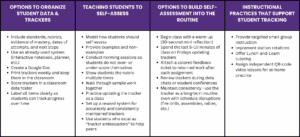
Learning becomes transparent, purposeful, and equitable when students track data and engage in consistent, meaningful reflection. Motivation inevitably rises because students understand their progress and accuracy in grading improves because parallel data exists. Bias decreases or remains in check because grades reflect evidence as opposed to perception. Trackers and reflection tools don’t just change how students receive and interpret their grades; they reflect how they understand themselves as learners, and indeed, captains of their ships.
By: Dr. Nanci Brillant, Crescendo Education Group Coach
About the Author:

Dr. Nanci Brillant has provided Professional Learning (PL) at the school, district, and state levels in Florida and Maryland, covering topics such as Creative Classrooms, Student Engagement, Teacher Leadership, Arts Integration, Grading for Equity, and PL for new teachers entering the workforce. As an NBCT, she is continually honing her practice and sharing ideas with others. Recognized as a Florida high-impact teacher (top 1%) and as a finalist for TOY for the state of Florida, and having received Official Citations from the Maryland General Assembly for excellence in education, she is on a one-woman mission to turn apathetic students into creative and critical thinkers, one classroom at a time. She has been teaching since 2003 and has been with CEG since 2021.